Flare Leggings on Stairs and Escalators: The Hem Problem
Quick Answer: A flare hem is measured against flat ground, but stairs and escalators change the geometry — your rear foot lifts less, and the hem passes through the space where the step edge is. The reliable clearance is 1 to 2cm above the floor in the shoes you will actually wear, and escalators need more than stairs because of the comb plate gap. If you have ever felt a tug at the hem on a stair, the length is wrong for that shoe.
Most hem advice is about proportion. This one is about the fact that a hem that trails slightly is genuinely a trip risk in exactly two places, and both of them are unavoidable in a city.
It is a five-second check and most people have never done it.

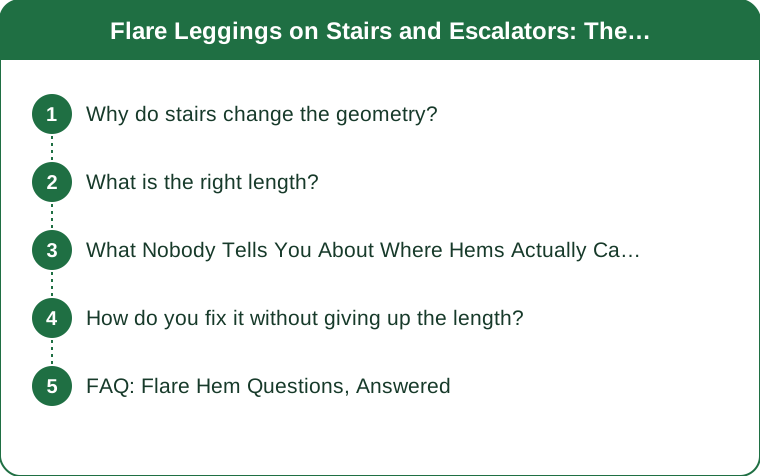
Why do stairs change the geometry?
Because ascending a stair changes how much clearance the trailing foot has, and a flare hem sits directly in that path.
Walking on a flat surface, your foot lifts several centimetres and the hem swings clear beneath it. On a staircase, ascending, the trailing leg passes very close to the edge of the step above — the whole point of a stair is that the vertical gap is minimal. A hem that sits at or below the sole line on flat ground is now passing over a hard edge with very little room.
The failure is a catch, not a trip. The hem hooks the stair nosing, the leg continues, and either the fabric pulls sharply or your stride is interrupted mid-step. On a staircase that is genuinely dangerous rather than merely annoying.
Descending is a different and lesser risk — the hem tends to swing forward and clear. Ascending is where it happens.
The escalator problem is separate and more serious. Escalators have a comb plate at the top and bottom where the steps flatten and disappear into the mechanism. That is a moving gap designed to be narrow, and long fabric can be drawn into it. Safety guidance around escalators specifically mentions loose clothing for this reason.
The practical version: if your hem drags at all — and a hem that clears when standing can drag when walking, because the flare swings — an escalator is not the place to find out.
Wet weather makes both worse. A damp hem is heavier, hangs lower and clings, which is worth knowing as the wetter months arrive.
What is the right length?
Measured in the shoes you will actually wear, not barefoot in a bedroom.
The working rule: 1 to 2cm of clearance from the floor when standing still in the shoes for that outfit. That sounds short on paper and it is the length that stays clear when the hem swings during walking.
Why swing matters: a flare leg moves forward and back with each stride, and at the extreme of the swing the hem is closer to the ground than when standing. A hem that just touches the floor when static will be dragging at the front of every stride.
The shoe problem is the whole problem. Flare leggings are typically bought and hemmed with one shoe in mind. Change from a boot with a 4cm sole to a flat trainer with a 2cm sole and you have just lost 2cm of clearance — which is the entire safety margin.
Practical answers:
Own one pair per shoe height if you wear flares often. Unromantic and effective.
Have a pair professionally hemmed for your most-worn shoe. It costs very little and it is the single best thing you can do for a pair you love.
Keep a flat-shoe pair and a heeled-shoe pair explicitly labelled in your head, and stop trying to make one work for both.
The check that takes five seconds: in the shoes, stand in front of a mirror and take three normal steps. If the hem touches the ground at any point in the stride, it is too long for those shoes and for any staircase you meet today.
Petite sizing exists for this reason and is worth using rather than compensating with heels. A standard-length flare on a shorter frame is the most common version of this problem.

What Nobody Tells You About Where Hems Actually Catch
It is rarely the places people worry about, and reliably the places they do not.
Stair nosings with a metal edge strip. Public buildings, stations and offices have anti-slip metal or rubber nosings that protrude slightly and have a defined lip. This is the number one catch point, far more than a plain concrete or carpeted stair.
Escalator comb plates, as above, and specifically at the top where you are stepping off and looking ahead rather than down.
Car door sills. Getting out of a car with a long flare frequently drags the hem across the sill, which is wet and dirty in autumn. Not dangerous, and the fastest way to ruin a hem.
Your own heel. The most common everyday catch is stepping on your own hem with the opposite foot, which happens at the back of the stride on a hem that is only slightly long. It produces the characteristic frayed, greying back hem that eventually splits.
Kerbs and shallow steps are underrated because you do not lift your foot much for a 10cm step. A single kerb catches hems more often than a full staircase, because nobody is paying attention.
Bike pedals and scooter decks, if either is part of your commute. A flare hem near a chain is a genuinely bad combination and worth a clip or a roll.
The tell that your hem is too long even if you have not caught it: look at the back hem. Wear, fraying, discolouration or a hardened edge along the rear means the hem is contacting the ground regularly, whether or not you have noticed.
How do you fix it without giving up the length?
Several options, in order of how well they preserve the look.
Have them hemmed properly. A tailor can shorten a flare while keeping the flare shape, which is the part people worry about. It costs a small amount and is the correct answer for a pair you wear often. Bring the shoes.
Match the shoe to the hem rather than the reverse. If a pair is long, it is a boot pair. That is a legitimate decision and it means one pair works perfectly rather than two pairs working badly.
Use a shoe with a defined sole for the stair-heavy days. An extra 2cm of sole solves the clearance question without touching the garment.
Roll or cuff for the commute. Unfashionable, entirely practical, and reversible. A single fold at the hem removes 3 to 4cm and takes seconds. For a rainy commute it also keeps the hem out of the wet.
Choose a slightly narrower flare if this is a recurring problem. A dramatic flare has more fabric swinging further from the leg, which increases both the catch risk and the drag. A moderate bootcut behaves considerably better on stairs and looks similar under a long top.
What not to do: hemming tape and quick fixes on stretch fabric usually fail, because the tape has no give and the fabric does. A stretch hem needs a stretch stitch, which is why a tailor is the better answer than a home fix on this particular garment.
And the seasonal note: this becomes more relevant over the next couple of months. Wet pavements mean a dragging hem is soaked and heavy within minutes, and the switch from summer flats to autumn boots and back changes clearance week by week. Checking the hem against today’s shoes is a genuinely useful thirty seconds in the morning.
FAQ: Flare Hem Questions, Answered
How much clearance is enough?
1 to 2cm from the floor in the shoes you are wearing, checked while walking rather than standing. That covers stairs, kerbs and normal stride swing.
Are escalators actually dangerous with long hems?
The comb plate at either end is a genuine entrapment point and escalator safety guidance specifically warns about loose clothing and long items. It is not a common accident, and it is a serious one when it happens. Keeping fabric clear at the top and bottom is a reasonable habit.
Can a tailor shorten a flare without ruining the shape?
Yes — a good one takes the length from the hem and preserves the flare angle. Bring the shoes and stand normally while they pin it. This is a routine alteration.
Why does the back of my hem wear out first?
Because it is contacting the ground during the stride, or you are stepping on it. Both mean the hem is too long for that shoe, and the wear pattern is the evidence.
Should I just buy petite?
If standard lengths are consistently too long, yes. It is a cleaner solution than either permanent heels or permanent rolling, and petite flares keep the intended proportion of the flare itself.
Does the hem length rule change for bootcut?
Same clearance rule, but bootcut is more forgiving because there is less fabric swinging away from the leg. If stairs are a daily part of your commute, bootcut is the lower-maintenance choice.
TL;DR:
- Stairs remove the clearance a flat floor gives you; ascending is where hems catch, on metal stair nosings especially.
- Escalator comb plates are the one genuine entrapment risk — keep fabric clear at the top and bottom.
- The rule is 1 to 2cm above the floor in the shoes you are wearing, checked while walking.
- Check the back hem for wear. Fraying means it has been contacting the ground whether you noticed or not.
- Hem for one shoe height, or match the shoe to the hem. Trying to do both badly is the actual problem.
Thirty seconds and a mirror before you leave, in today’s shoes. It is the whole fix.
See It in Motion
Seen here: High Waist Yoga Leggings with Side Pockets — shop it on bubblelime.com
Keep Reading
This article is for general informational and styling purposes only. Fit, sizing, and product availability may vary.